
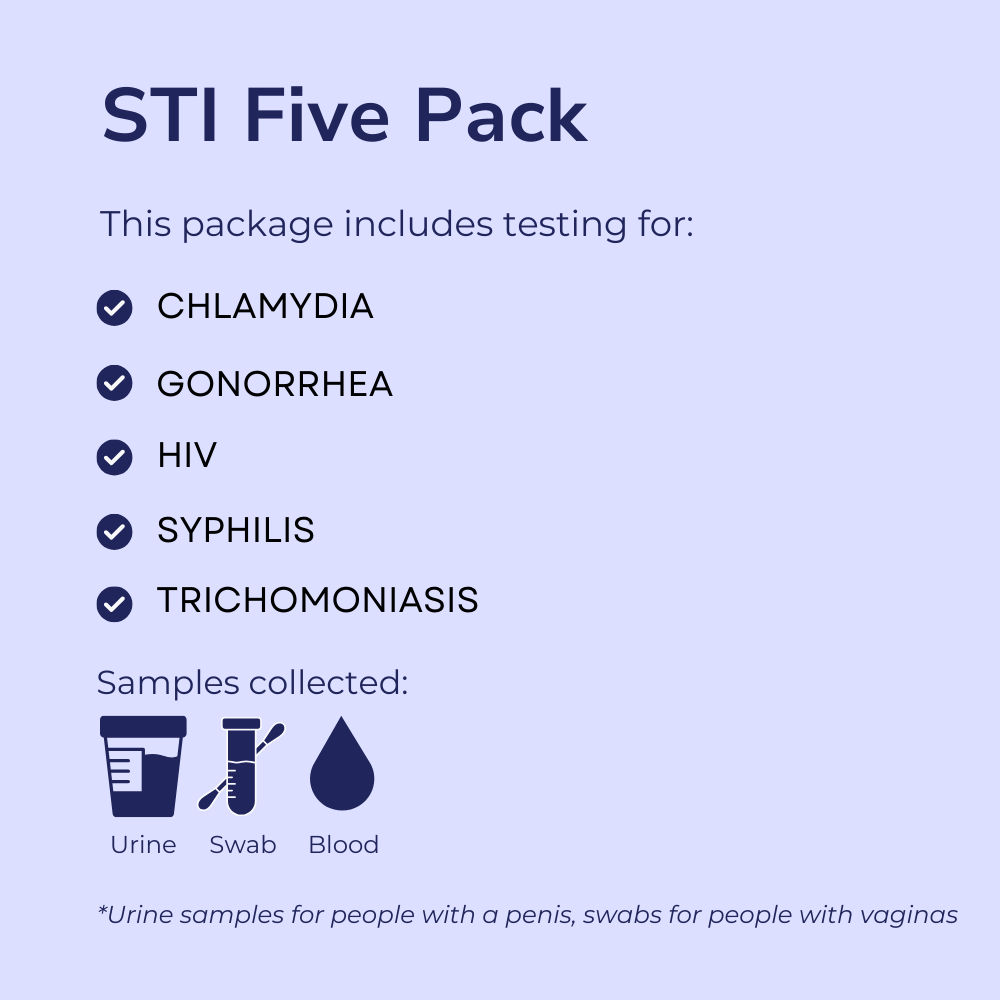
This package covers three common STIs—chlamydia, gonorrhea, and trichomoniasis—as well as HIV and syphilis.
$139.00
The “window period” for testing refers to the time it takes for a test to be able to detect an infection after exposure. So, you should test after the window periods below to ensure your test is accurate. If you have already tested before the window period, you should repeat the test, especially if the initial test is negative.
Different STIs have different window periods:
Testing is either done with a urine sample (for people with a penis) or a vaginal swab (for people with a vagina). The HIV and syphilis tests are done with a blood sample. A step-by-step guide for providing each sample type is available here:
You will receive a text or email message notifying you that your results are available. To access your results, you will log in to a secure web portal.
You should be notified within approximately 10 days. If your kit was sent over 10 days ago and has still not been logged as received, please contact us and we will send you a replacement kit.
A negative result for any STI means that you didn’t have that STI at the time your sample was collected. If you tested before the end of the window period for a possible exposure, testing again once outside the window period may be recommended.
A positive result (which may appear as “reactive” or “detected” on your results report) means that you do have an STI and treatment by your health care provider is recommended. Remember, all STIs can be treated and many are easy to cure.
You’ll need to follow up with a health care provider to get treatment. You can request a free telehealth appointment via your Dx YourWay patient portal or bring your results to your own health care provider. If you don’t have a health provider, you can search for a clinic near you here.
It is also important you tell any current or recent sexual partners so that they can be tested and treated. To avoid passing the STI on to your sex partner(s), it’s recommended that you don’t have sex (even with a condom) until you’ve completed your treatment and no longer have symptoms (if you had any).